Everyone Is Chasing the Same Ball
By Damon Anderson, 26 August 2026. 7 minute read.
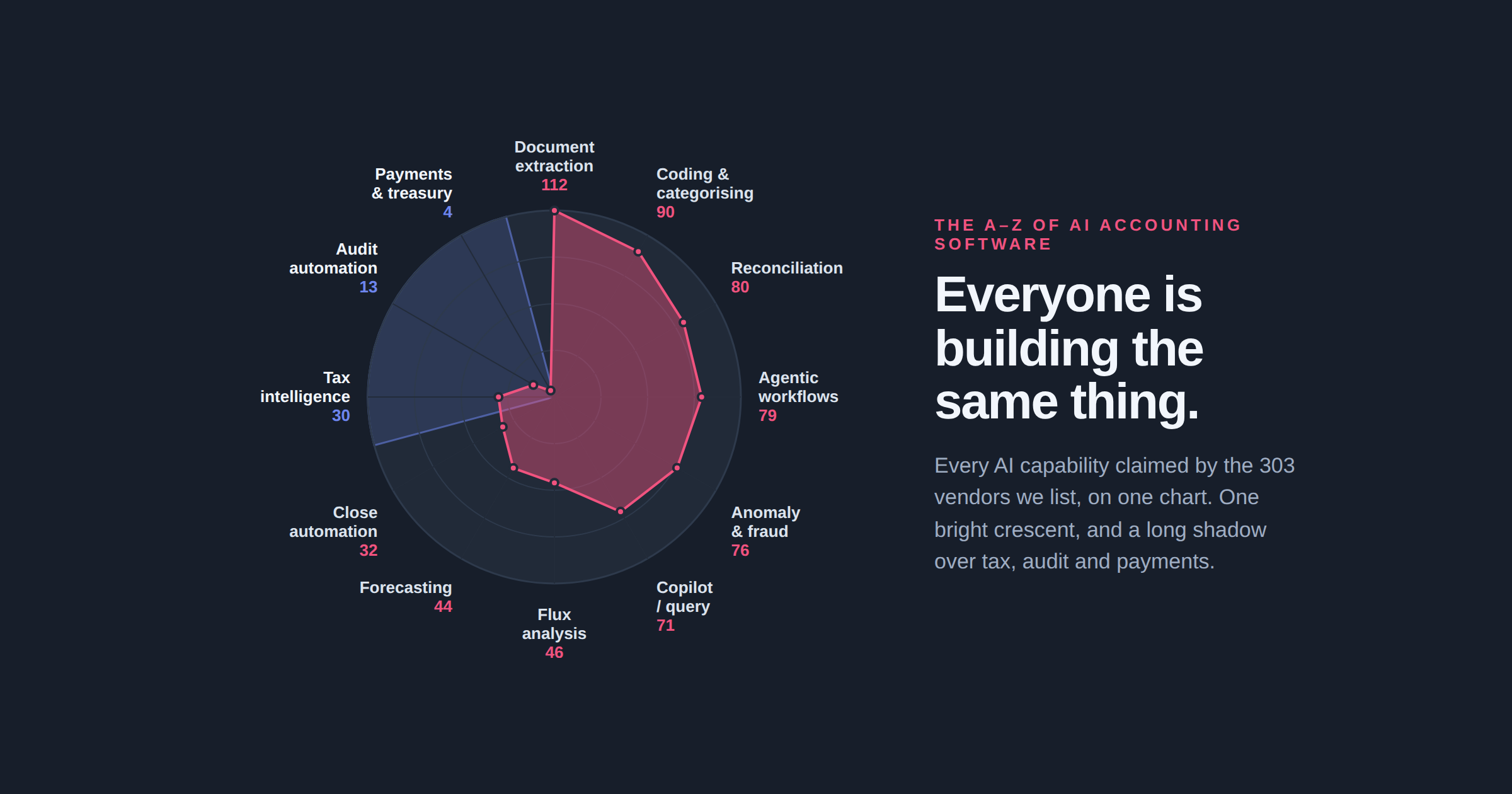
We have assessed 381 accounting software vendors. 303 of them are good enough to make the published A–Z. Every one carries AI capability tags. What they say their AI actually does, in their own words, on their own site. I've plotted the lot across all 303 (and counting) to work out where all the effort currently lives.
I was not exactly expecting an even spread. But set it against the full remit of jobs to be done in accounting and it is a genuinely surprising asymmetry.
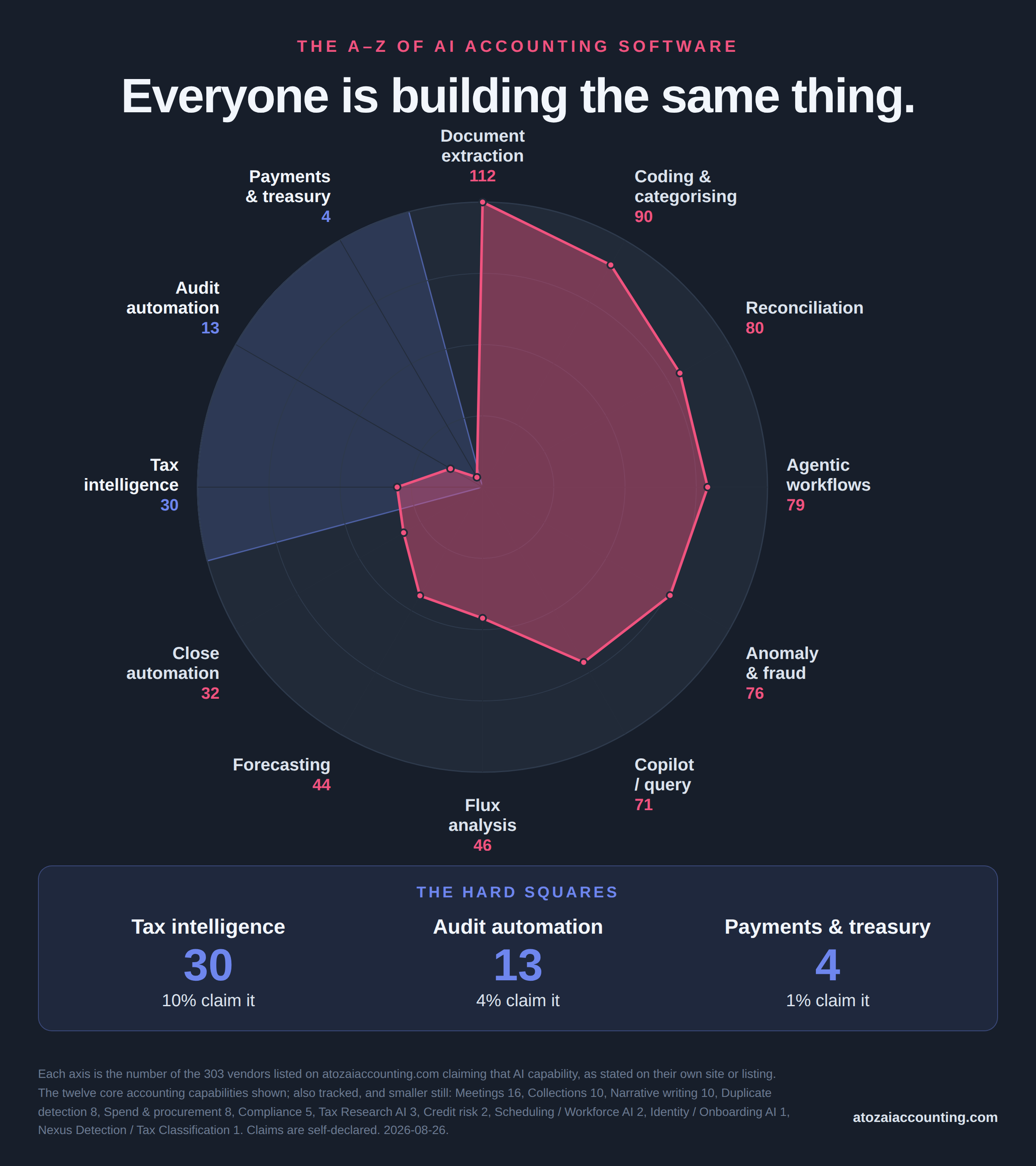
One bright crescent, casting a long shadow over everything else.
The crescent is the bookkeeping workshop. Document in, coded, reconciled, flagged, ask it a question, let an agent run it. Two hundred companies have pointed their engineering there, and most are building all of it, not one slice. This is not a market with six crowded categories. It is a market where nearly everyone is building the same product.
The lurking shadow that remains is tax, audit, and payments. Not because nobody noticed, but because it is bloody hard graft. Each is hard for a specific reason, and that reason is the thing you have to beat.
Tax
The outside world has already moved. Blue J raised $122m in a Series D last August, seven months after its Series C. OpenAI took a stake in Thrive Holdings' $1bn accounting roll-up, seconded a team and pointed it at tax: seven thousand returns last season, 31% average time saving. It did not pick tax off a spreadsheet. It went where Thrive already owned the firms. Real files, real outcomes, a controlled place to learn.
Big money. Big players. Because scaling ain't for the faint hearted. Tax is not one market. It is hundreds. Every country, then every state, then in the US every county and city: north of 12,000 sales and use tax jurisdictions alone, sitting on top of federal rules and fifty separate state regimes. It makes my head hurt. Every one of those needs its own authoritative corpus, and you either build it or licence it. Blue J did both, and on top of $122m it still had to buy in third-party content to reach 220-odd jurisdictions. Coverage is the moat, and coverage is a bottomless pit of cash.
The UK players are also an interesting watch. Syntax.tax is going at UK practices and the planning and review work that still lives in spreadsheets. TaxGPT is closer to the Blue J model. And this is not a UK quirk: Germany already has SteuerLLM, an open-source model trained on German tax law that outscores much larger general-purpose systems on German tax exams. Domain data matters more than parameter count. Every jurisdiction will grow its own.
And then the incumbent nobody looks at. TaxCalc is one of the more established names in UK tax software. Trusted, widely installed and competent. However, it carries no significant AI and only moderate connectivity. Decades of domain knowledge and an entrenched base is a formidable position, right up until somebody cloud-native makes leaving easy. UK tax is waiting for that company. I do not think it has arrived yet.



Audit
Thirteen vendors. That is the entire field as we currently have it mapped in the A to Z so far.
Fieldguide is the standout, and nothing else in assurance is close to it: a $75m Series C from Goldman at a $700m valuation, and the only platform in the category we rate at the top of our AI maturity scale. MindBridge tests 100% of transactions rather than a sample and sits inside KPMG Clara. DataSnipper made itself indispensable inside the tool auditors already live in.
Closer to home, Inflo and Validis in the UK and Dublin-based Circit are all active here and all doing serious work on the plumbing of an audit. Worth saying plainly, though: none of them scores highly with us on AI. They are good audit businesses that have not yet become AI businesses, and that gap is the opportunity sitting in front of them.
Audit is thin because of who buys it. A handful of firms do the work that matters, and they have the budget and the engineers to build it themselves. Below them is a long tail with neither. Add a regulator with no appetite for "mostly right" and you have very few real buyers and a very long sales cycle.
Which is why Fieldguide is not evidence that audit is easy. It took $125m and half a decade to get one company to the top of a field of thirteen. That is the cost of entry, not proof of an open door.



Payments
The constraint here is not really AI.
Accounting and payments done properly both demand deep institutional knowledge and serious investment, and almost nobody has built both. Accounting software is a system of record: it tells you, precisely, what already happened somewhere else. The prize is turning it into a system of action, and that keeps getting solved, just never by the accounting vendors. Xero paid $2.5bn for Melio rather than build one. Ledgers acquire payments because authorisation, safeguarding, capital and fraud operations are not a roadmap item. They are a different company altogether.
Which is why Adfin's model is the clever one. The money movement sits with FCA-regulated partners, currently Adyen, Stripe and Tink. What Adfin keeps is the layer above: the decision about who to chase, when, and how to collect, down to retrying a failed Direct Debit and then dropping the customer a card link instead. Someone else carries the licence, Adfin owns the customer, and goes straight at GoCardless' jugular while it's at it. Apron works the same constraint from the payables side.
But that is still plumbing bolted to the side of the ledger, and it undersells what payments is worth.
If you have read the A–Z report, I talk a lot about Dext's delay-day index. Fifty to sixty days: the average gap between a UK document being created and it reaching an accounting system. Every real-time claim in this industry has to survive contact with that, and most dissolve on impact.
A payment is the only moment in the chain that sits exactly on the economic event. Not a bank feed six weeks later. The transaction itself, at the point of purchase, knowing the merchant, the amount, the date, whether that supplier is VAT registered and what their number is. Capture that, attach the receipt, pass it into the ledger, and you have not improved reconciliation. You have removed the need for it altogether.
The respective vendors in this space can come at the problem from differing starting points. Accounting software can move upstream into the payment. Banks can move downstream into the books, and Tide reckons more than one in ten new UK businesses now opens its first account with them, with Tide Accounting built straight on top. Allica Bank has the opportunity to run the same logic further up the market. They start with the money and walk backwards into the books.
It only takes one business bank to treat transaction capture as a product rather than a feature. Payment economics, the bookkeeping, and a lending book underwritten on data nobody else has. Nobody has taken it because it needs two kinds of deep institutional knowledge, banking and bookkeeping, in one place, and the two industries have never properly worked out how to sit together.







So where would you play?
The two hundred companies shipping products in the crescent are not daft. They are in the one part of this market that is the obvious beachhead. It is easy to sell into: no licence, no regulator, short sales cycle, and a buyer who already knows they have the problem.
But it is like watching an under-nines football team. Everyone chases the ball, because the ball is obviously where the game is, and nobody wants to be the one standing in an empty corner looking silly.
The shadow is not the obvious place to hang out, but the rewards for the player who takes their spot are immense. The emergence of AI is not exactly dragging investment into tax, audit or payments, but you can choose it: pick a jurisdiction and win it, survive a long sales cycle into very few buyers, or become a regulated business. None of it is quick. All of it is defensible for a decade if you win.
For the first time there is a proper register of where innovation in accounting is actually happening. It says everyone is chasing the same ball. And it leaves some very interesting spaces on the field still to play for.
This analysis is built on self-declared capability tags. The A–Z also carries a verified, evidence-based assessment for a subset of vendors. If you are a software vendor working in this space and you are not listed, or your listing is wrong, get in touch.