Who's left holding the bag when the AI bubble bursts
By Damon Anderson, 18 September 2026. 9 minute read.
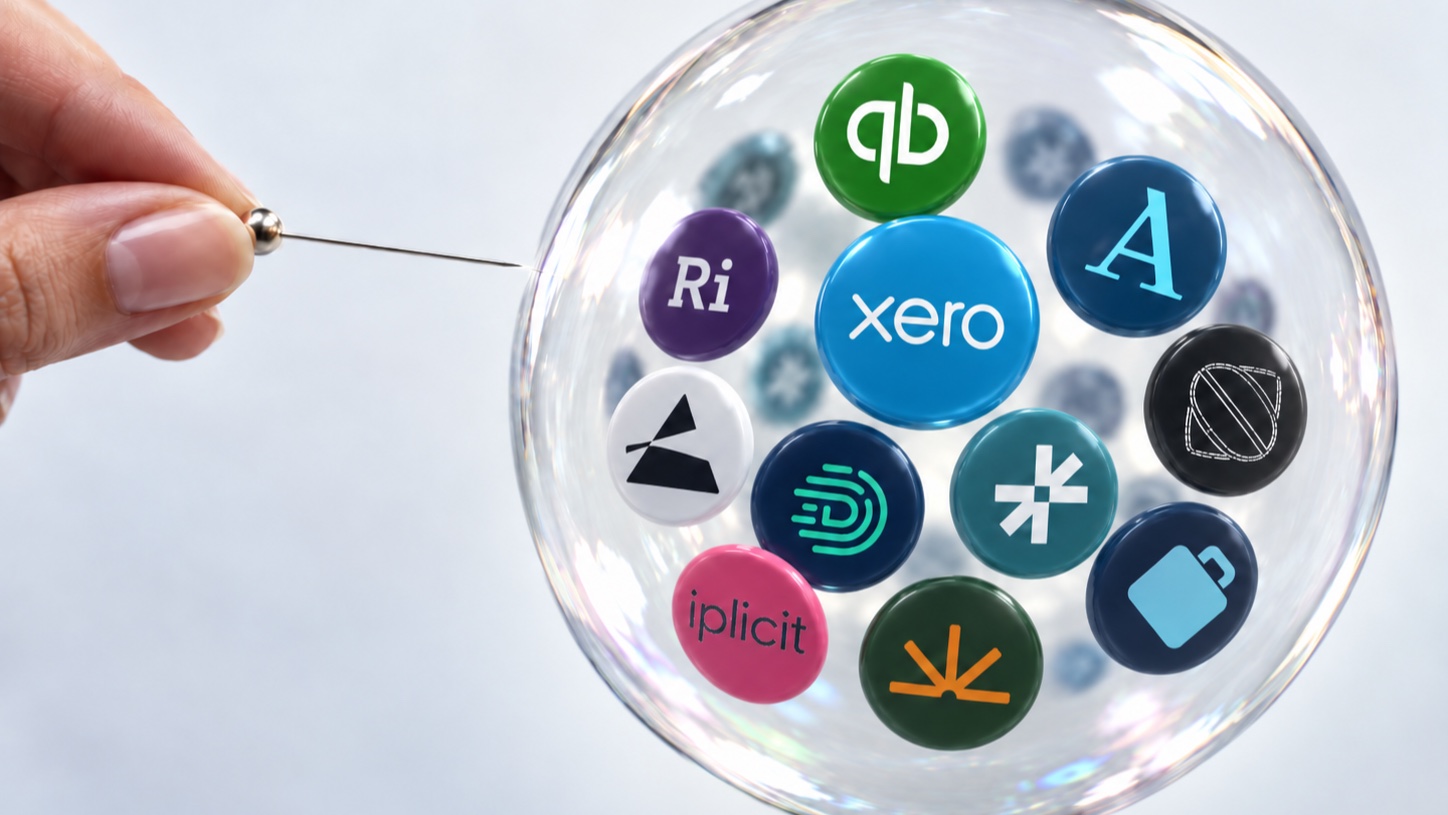
Over the weekend the people who build the most powerful AI systems in the world asked everyone to slow down. Not the critics. Themselves. Dario Amodei, who runs Anthropic, published an essay called "We Must Pace the Frontier" and told CBS that "for too long the industry lied to people about the fact that this technology had risks." A few days earlier one of Anthropic's own researchers resigned in public and wrote that the labs were "gambling with our lives."
Ed Zitron, who has spent two years calling the whole thing a con, compared OpenAI and Anthropic to WeWork on the CNBC desk, and the market shuddered the moment the labs said the word slower. Is it a bubble? Yes, almost everyone says so, including the people inside it. What nobody is telling the accountants, finance directors and business owners who bought the latest bit of AI kit is what a pop does to it.
So when you sit down with a cup of tea to pick your AI accounting software poison, there is one question worth more than any feature list. What does your vendor own, and what are they renting?
Starting the race is easy
Starting is easy. Finishing is hard, and placing is nigh on impossible.
Nobody serious now disputes that the technology works. I am converted; I have looked under the hood of 393 companies in this market, and this stuff works. However, that is a lot of companies. So the real question is which ones are standing on their own solid foundations, and which are standing on someone else's.
We have seen a version of this before, in the cloud era, but never this cheap or this fast. Gary Turner ran Xero's UK business while the industry helped desktop software pick a plot at the cemetery, and watched the cloud lower the cost of building software, which is why every ledger now carries a thousand apps in its marketplace. AI has lowered that cost again, to almost nothing. In his words:
What is different now is that LLMs have crushed the design and build effort of bringing a new product to market, lowering the barrier to somewhere close to zero, with the result that many AI-era products are appearing that would never have cleared the regular VC funding threshold, are not commercially viable (these are more like 'deepfake' apps that have duped their creators), and will not survive a funding drought.

LLMs have created a sea of shiny websites, full of promise. But a drought is coming, and you can see the signs already. Of the 2,718 AI tools tracked by ToolDirectory.ai, 254 had shut down or been absorbed by August, and the count is rising. Stuart McLeod, who founded Karbon and now runs Archie, an agent platform for accounting firms, put it plainly: "If funding dries up, what happens is always what happens. The companies with revenue survive, and the companies burning tokens at a billion miles an hour will die." An idea, a Claude licence and a few quid gets you to the start line. It doesn't get you to the end of the race.
The money merry-go-round
Every time an AI product does something for you, it consumes tokens, which is the unit the labs charge in. A token gets processed on a chip, mostly Nvidia's, in a data centre that has to be powered, so behind every AI feature there is a physical supply chain that wants paying.
The price of a token keeps falling, but AI doesn't get cheaper, because cheap tokens just get used for more. An assistant that used to answer a question now reads the whole ledger, and the newest model is always full price. Yesterday's AI gets cheap. Keeping up never does.
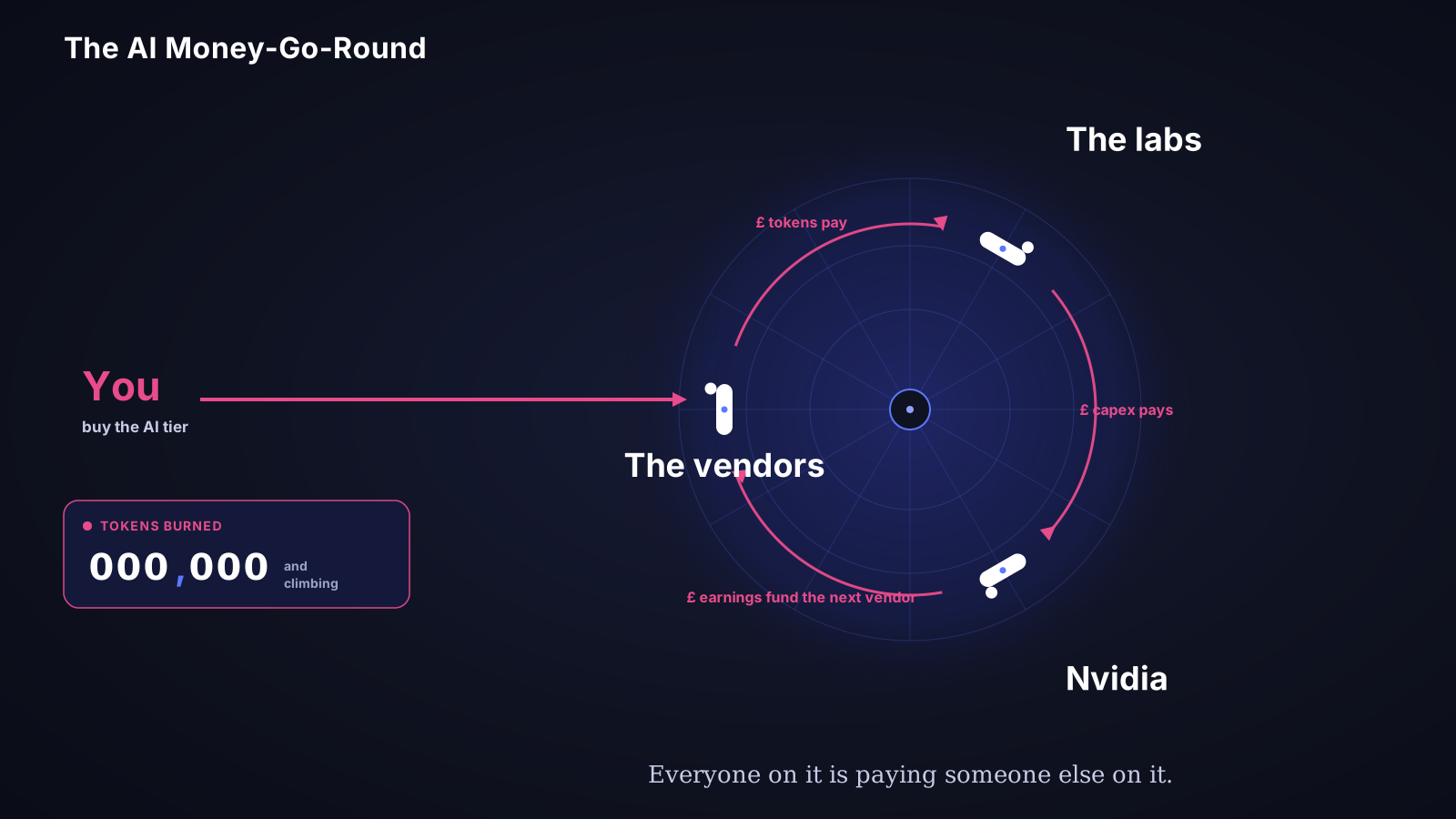
McLeod calls the bigger version of this the money-go-round: "Nvidia into Anthropic, into OpenAI, into Nvidia, into Oracle." Your end of the ride is the same shape: your AI tier pays the vendor, the vendor's tokens pay the lab, the lab's capex pays Nvidia, and Nvidia's earnings fund the next vendor. Everyone on it is paying someone else on it, and the only new money coming in is yours and the venture funds'. And the ride is not paying for itself. OpenAI lost about $21 billion on $13 billion of revenue last year, according to leaked financials reported by Fortune, and burned another $3.7 billion in the first three months of this year. When reports surfaced in April that it had missed its revenue targets, Oracle and the chip stocks fell the same day.
A ride like that runs until somebody stops paying. Then it stops being a ride and becomes a very expensive machine that still has to be maintained, and whoever is standing closest gets the bill. Which raises the question for anyone buying accounting software: how close are you standing?
Why accounting is different, and who is on a short-term lease
What happens to the accounting industry when the market corrects will be incredibly interesting to watch, because delivering core accounting is largely not a generative task. Jeff Seibert, chief executive of Digits, which tops this month's A to Z World Ranking, put it bluntly. "Accounting is not generative. Done correctly, it's a deterministic function over its input data. LLMs are bad at it."
That is the whole argument, really. The product is a set of books that reconcile and that somebody will sign, and a wrapper around someone else's model cannot be that. The model can work out what needs doing, but code somebody has built and owns has to do it.
Think of the labs as power stations: colossal capex, unit price theirs to set. The wrappers, AI-first tools that are a front end on someone else's model, are the appliances: useful, dead the moment the grid goes down or the tariff doubles. The incumbent ledgers, NetSuite, Sage, Intuit and the rest, have plugged an appliance into that grid. A handful of companies have put solar panels on the roof instead.

- Category
- AI-Native Ledger
- Founded
- 2018
- Built for
- SME, Mid-Market
- Markets
- US
Digits is one; it trains its own accounting models and runs its own inference. Campfire, second in the same ranking, built its own foundation model and runs it on its own GPUs, and its founder John Glasgow says the reason is simple: "As models become commoditized, the value is shifting from the model to the harness." Both still touch a frontier model for some tasks, but their core cost is fixed, paid once, and not the lab's to reset. That is what owning the ledger and the brain looks like.

- Category
- Traditional GL
- Founded
- 2019
- Built for
- Mid-Market
- Markets
- UK, Ireland
Then there is the other end of the market, ledgers built before any of this that chose to bolt the intelligence on rather than build around it. Lyndon Stickley runs iplicit, a cloud ledger nearly ten years into trading, and he is unapologetic about it: the ledger, the controls and the numbers first, and the intelligence as something the customer switches on "when and where it adds value, not something applied to them wholesale." I asked him which part of his business survives if every model becomes cheap and equal. "If every model gets cheap and roughly equal tomorrow, the moat was never the model. Anyone can copy a feature, or vibe code a slick demo in a weekend and have a working version not long after." He is blunter still on where the responsibility sits: "When filed accounts are incorrect, nobody asks which software produced the figures. They ask who signed it. Software that can't be held liable has no business making the decision alone."
However, the choice isn't only wrapper or traditional. Campfire and Digits are proof of a third way: own the ledger and build the intelligence underneath it too.
So the incumbents are safe on the books and exposed on the brain, the wrappers are exposed on both, and a handful of natives are exposed on neither. The wrappers are where a burst bubble leaves most of its mess, because their entire premise is rented from a lab that now needs to slow down and recover its capex. The incumbents feel it second hand, in the price of the AI tier they bolted on and the pace of a roadmap that was never theirs to set.
Which gives you the one question that matters before you sign for anything with AI in the name. Which layer of this is yours, and which is rented?
Who is left holding the bag
So the labs are slowing down. Perhaps they're genuinely frightened, or perhaps they've realised they are in a race to the moon, and the receipts have given them a nosebleed.

- Category
- AI-Native Ledger
- Founded
- 2023
- Built for
- Mid-Market, Enterprise
- Markets
- UK, US
Whatever the motive, be specific about what a pop actually is. Not just a line on a stock chart, but the venture money stopping. The next round for the AI-first tools doesn't come, the tools run out of runway, and the 254 that have already shut down becomes a thousand. The labs lose the revenue those tools were spending, the commitments to Oracle and Nvidia stop being affordable, and prices move, most likely up. That is who is left holding the bag. Not the ledgers, which still have your data and your custom. Not Digits or Campfire, whose cost per client doesn't move when the lab's does. The AI-first tools with nothing owned underneath them, and the businesses that bet their workflow on one.
Owning the brain is not a free pass, though, and it would be odd to let Digits and Campfire off the hook just because they top my ranking. A model you train yourself can fall behind the frontier, and customers notice the day a rival's rented model does something yours can't. GPUs you own are a fixed cost, which is lovely while revenue grows and painful when it doesn't. Their bet is safer in a pop. It isn't risk-free.
For a firm or a finance team buying this software, that is the whole point. A pop doesn't take your books away. It thins out the tools sitting on top of them, and the price of the intelligence inside the ones that survive won't necessarily go down.
Where that leaves you
None of this AI news guarantees the bubble pops next year, or at all. But a bubble has layers, each one a different distance from the money, and you are being asked to spend and change how you work in the middle of a land grab.
Make it concrete. Picture a practice with forty bookkeeping clients that moved its transaction coding and month-end reviews onto an AI-first tool last year, at a flat fee per client. The tool's next funding round doesn't come, and it gives ninety days' notice. The books are probably fine; they'll still sit in Xero or QuickBooks as they always did. What goes is everything the practice built on top: the coding rules it trained, the review workflow its team learned, the client portal, and the fees it set on the assumption the tool would keep doing the grunt work. Some of it exports, the rest gets rebuilt, and the replacement costs more, because the new vendor is renting the same brain at the new price.
None of that shows up in a demo.
So match your approach to your appetite. If you want to be early, be early, but look beyond the flashy website and work out which vendor owns what. If you want to be safe, pick your accounting system on its own merits first, and treat the AI on top as an add-on you could drop tomorrow without your month-end falling over.

Turner has the last word on it: "The people selling the shovels should be OK," he says, "I'm not sure about the miners." The labs take a hit and survive, because everyone still needs what they sell. The AI-first tools built on borrowed intelligence mostly don't, because when the funding stops there's nothing underneath them. And the ledgers, the ones that own the books, the rules and the data, come out of it with their customers intact. When the music stops, the books still have to close on the first of the month, and somebody still has to sign them.