Survival of the Fittest: The AI SaaS Accounting Software Wars Begin
By Damon Anderson, 8 February 2026. 4 minute read.

There's a lot of noise in Software as a Service (SaaS) right now, and the accounting software space is not immune.
Public SaaS share prices are nosediving, while large amounts of capital — mostly out of the US — are being pumped into AI-first companies armed with hype machines promising agentic general ledgers, autonomous agents, and 99% accurate reconciliation. Forget the month-end close; it's day-zero close.
Xero was once the David vs Goliath story, built to unseat Intuit. Today, a new generation of founders talk about it as if it were a legacy "cloud-era" incumbent.
Some of that is classic "sell the sizzle" disruptor hype. Some of it is blind optimism. But all of it equates to a lot of noise.
Beneath it all, something fairly ordinary, and far more important, is happening. And it's not that the market is being disrupted. It is that it is being selected.
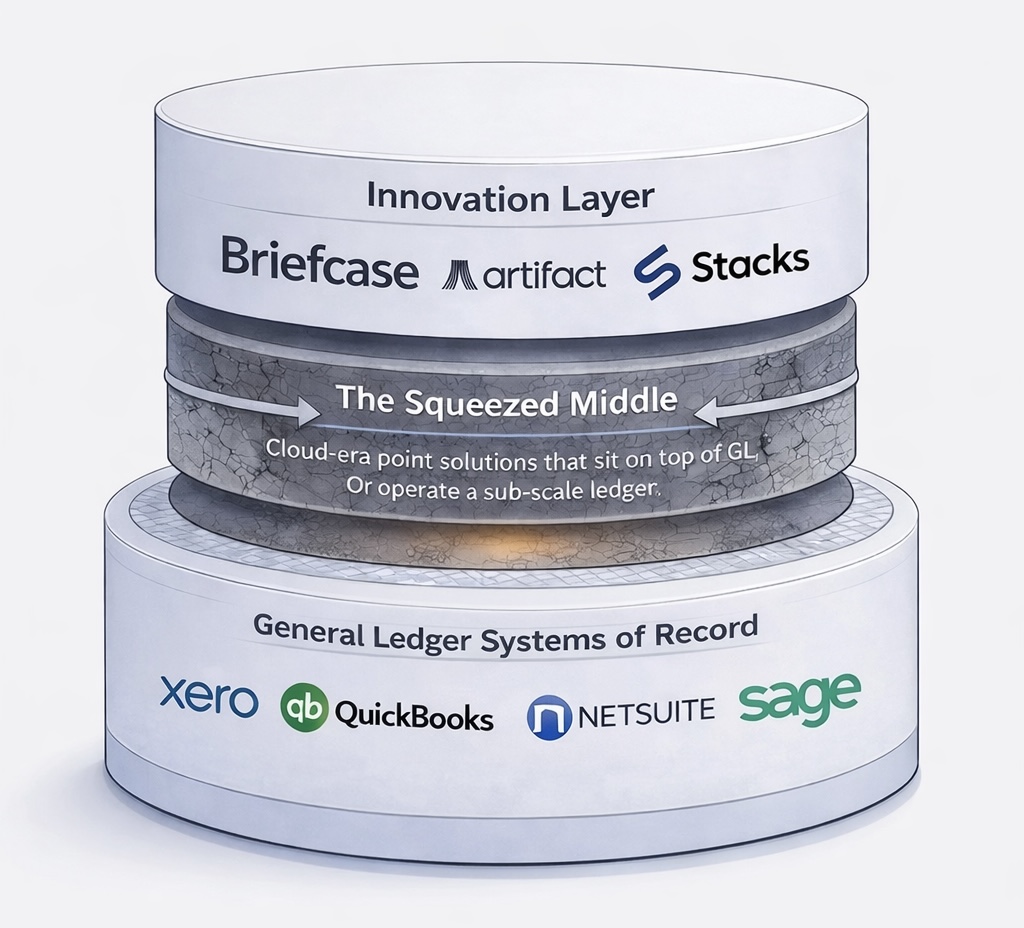
When you strip away the hype, you start to see the emergence of three types of players in the AI wars: the big systems of record that own the data, nimble AI-first players improving real-world outcomes, and an increasing number of new entrants that appear to do neither.
Systems of Record
These are the platforms that own the ledger, the history, and the trust.
Companies like Intuit (QuickBooks), Xero, and NetSuite all sit firmly at the centre of their respective ecosystems. They hold decades of financial data, deeply embedded workflows, and enormous distribution.
There is no shortage of companies claiming they will replace them. Digits, Puzzle, and Dual Entry are all making bold claims with GL-centred ambitions, and no doubt making plenty of enemies in the boardrooms of the software giants along the way.
But the reality is they won't be replacing them — at least not quickly. The big systems of record players all have deep pockets, active reinvestment strategies, and the advantage of already being woven into how businesses actually operate. AI does not weaken that position. It strengthens it. This is what scale looks like once it has been earned.
The Innovation Layer
Most of the genuine innovation in accounting software is happening above the ledger.
In the US in particular, a growing set of recently formed AI-native companies aren't just claiming to deliver better interfaces or faster reporting. They are taking responsibility for the work itself. And they're starting where the opportunity is most acute: data capture, ingestion, and normalisation.
In the US, tools like Double (formerly Keeper), Numeric, or Maxima are just some of a lot of players in this space.
In the UK, the picture is much quieter. It's actually quite sad how little bold innovation is happening, save for some interesting use cases around the edges. Tools like Briefcase are concentrated on specific, high-friction parts of the process such as capture and month-end close. Artifact AI is applying AI across these and other adjacent workflows like tax and payments, showing how much value still sits on top of the ledger.
As I build out my global A–Z of AI-first software vendors, it's pretty clear this layer is where the big winners are surfacing — with actual customers, real revenue, and real-world outcomes.
These companies do not need to displace incumbents to matter. They only need to change expectations. And once that happens, everyone else has to respond.
Different approaches, but the same underlying point. Execution matters more than presentation.
The Squeezed Middle
This is where things get a bit more uncomfortable.
For a long time, this was a very good place to build. New companies with a nice value-added product, solving one aspect of the workflow or one part of the market, typically sitting on top of someone else's system of record, plugging a solid unmet need where Xero and QBO just didn't care.
That model created a lot of solid businesses — just look at the app stack in the Xero ecosystem. However, it is suddenly becoming a much harder place to defend.
These products improve parts of the workflow, but they do not own or dramatically change the outcome. That distinction is becoming existential.
Below them, the big GLs and systems of record own the data. Above them, execution layers built fresh in the AI era are automating outcomes entirely.
The Winners Will Start to Emerge
As I've been building out a picture of the global AI accounting software market, it's clear that there are simply too many products, too many similar stories, and too much capital all chasing the same problems.
Over time, they will filter down. Some companies will protect their position through scale and data gravity. Some will win by owning outcomes through execution and pace. And most of those in between will not survive the next round of selection.
The smart money is on the companies that have the potential to pull off both: scale and pace.
And in this story of survival, the sharpest teeth are rarely the loudest.