The Innovator's Dilemma Is Becoming the Innovator's Opportunity
By Damon Anderson, 26 March 2026. 6 minute read.
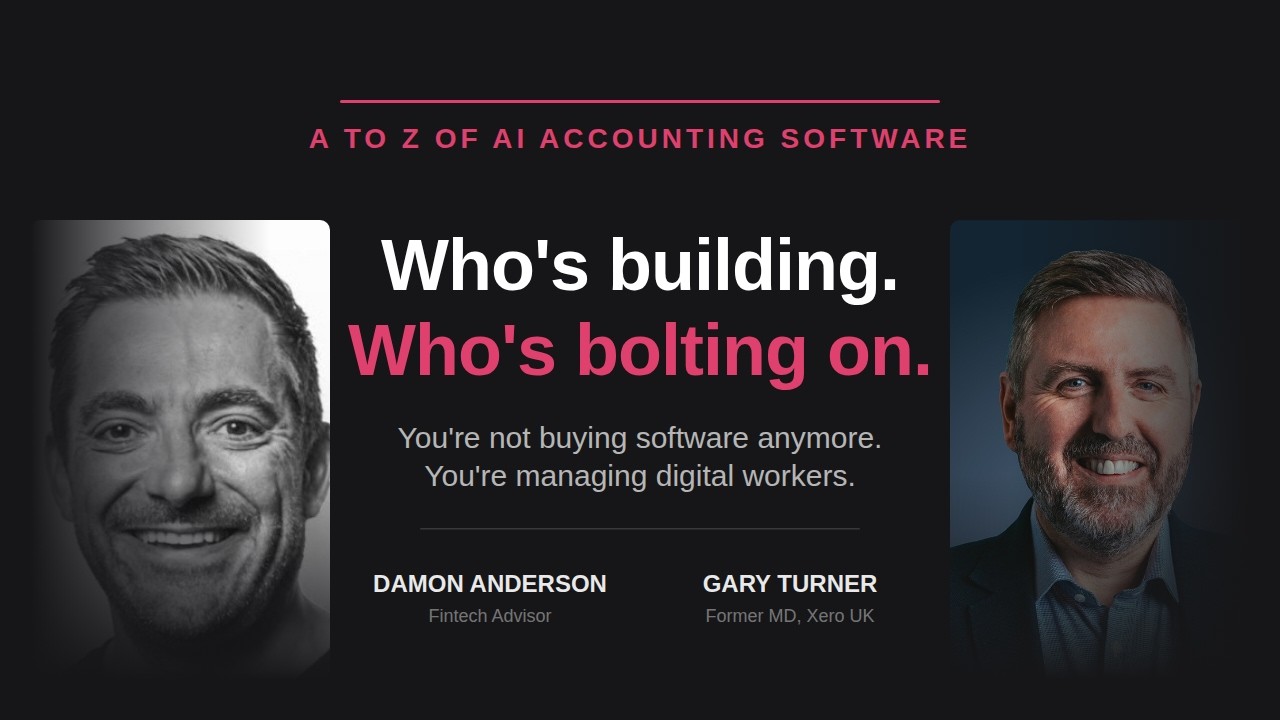
I did a webinar recently with Gary Turner, Xero's co-founder and former UK managing director, hosted by iplicit. The brief was simple: bring some clarity to what's actually happening in AI accounting software, as opposed to what's being claimed about it. What came out of the conversation was more useful than either of us expected going in.
The starting point is one I keep coming back to in the research for the report: the barriers to building software have collapsed. I'm now tracking well over 200 companies in this space, all of them solving some part of the accounting workflow stack, and a growing number of accountants are building their own tools rather than waiting for a vendor to ship the feature they need. Adam Pritchard at Lynford Gray Associates built his own profitability tracker because the software he had simply wouldn't do what he needed. Beffy Jones at Abakai now runs every single process in his business through Claude.
That's the 1% of the 1%. The interesting question is what it means for everyone else.
From chat to systems
Most people's experience of AI still sits at the chat level: ask a question, get an answer. But what's actually changing the shape of accounting work is the layer above that. First workflows, where repeatable questions get turned into repeatable processes. Then systems, where you delegate whole tasks to AI rather than performing them yourself. And now, increasingly, the ability to build entire products and experiences for other people, not just automate your own.
That last shift is the one that matters most for this report. When the cost of building a working product falls this far, the number of people capable of building one stops being a small, specialist group and becomes almost everyone.
The barriers are down. So is the ability to tell who's real
Gary made a point that reframed a lot of my own thinking. He was there for the last time this happened, when Xero and a wave of cloud accounting vendors displaced desktop software. In the early days there were, by his count, ten to fifteen credible cloud accounting competitors in the UK alone. Today, ask someone to name cloud accounting software and they run out of names after four or five. The market did what markets do. It selected.
But this cycle has an extra complication the cloud transition didn't have. As Gary put it, anything can look amazing now. A perfectly polished, well-designed, professionally photographed accounting app can be assembled in the time it takes to run a webinar. The conventional signals people used to judge whether a piece of software was trustworthy, a slick UI, a professional-looking website, a confident pitch, no longer tell you anything, because AI has made all of those things cheap to fake.
That has real consequences. If you're moving into agentic tools, you often can't even see what's happening; you give an instruction and the system goes away and acts on it, with no visible process to evaluate. Trust becomes the whole game. A great story and a polished interface aren't enough on their own any more. New entrants have to demonstrate real value quickly, and established brands that already have that trust have every reason to lean on it rather than cede ground to a wave of new vendors.
Orchestration is the new control layer
The theme that came up again and again, from both of us, was orchestration. For most of the SaaS era, the general ledger was the centre of gravity: Xero, Sage, Intuit and NetSuite owned the system of record, and thousands of apps plugged into the edges. What's emerging now is a layer above that, coordinating the agents and tools doing the actual work, rather than the ledger itself.
Products like Artifact AI, Basis and Archie are early movers here, shifting the job from practice management, managing staff, clients and workflow, to what I'm calling agent management. But there's a genuine fork forming underneath that. One path is DIY: as one accountant on the cutting edge put it to me, just get on Claude and start building, because everything else is noise. The other is purpose-built orchestration, designed from the outset for multi-firm, production-grade reliability rather than a weekend prototype. Archie's Stuart McLeod put it well: a DIY stack is a prototype, not production. What larger, acquisitive firms actually need is the ability to run dozens of agent teams on dozens of clients overnight, in parallel, with the reliability that implies.
My own view is that both paths are legitimate, and that most firms will end up using some combination of the two: DIY for the low-stakes, easily-rebuilt stuff, and a trusted platform for anything foundational to the practice.
The innovator's opportunity
Here's the part of the conversation I keep returning to. The classic pattern in every technology transition, the one Clayton Christensen wrote about thirty years ago, is the innovator's dilemma: incumbents are slow to respond because they're weighed down by legacy product, legacy business models and organisational inertia. That was true of desktop accounting vendors facing the cloud, and it's the assumption most people are carrying into this AI cycle too.
Gary's view is that it might not play out the same way this time. The productivity gains from AI-assisted coding aren't exclusive to scrappy startups. An established vendor with existing brand, existing distribution and existing trust can use exactly the same tools to spin up new product lines in months rather than years. It's not inconceivable, he said, that a large incumbent could launch five or ten new products in the next year, in categories they'd never previously been able to justify building. If that happens, this stops being a story about disruption and starts being a story about incumbents finally closing the gap Christensen described. The innovator's dilemma becomes the innovator's opportunity.
I don't think that makes the new entrants irrelevant. It does mean the assumption that AI automatically favours the smallest, fastest mover deserves more scrutiny than it usually gets.
Don't forget the customer
Gary's closing point was the one that stuck with me most, partly because it was aimed at me directly. He'd searched my briefing document for the word customer. It appeared once, and not even in a meaningful context.
That's an easy trap to fall into. It's genuinely fun to build orchestrations, watch agents work, and get lost in what's technically possible. But the point of any of this was never the tooling. It's the client at the other end of it, and whether their experience actually gets better. That's as true for a vendor building an AI-native product as it is for a firm adopting one.
We are, as I said on the call, not even 1% of the way into what this technology will do. The opportunity is ahead of us, not behind us. The practical advice from both of us was almost embarrassingly simple: get on Claude, try Claude Cowork, try the Claude Excel add-in, and start building something small. Don't wait for someone else's roadmap to tell you what's possible.