Xerocon Wrap: The Eagle Is Landing, and Now It Is Expanding
By Damon Anderson, 10 July 2026. 11 minute read.
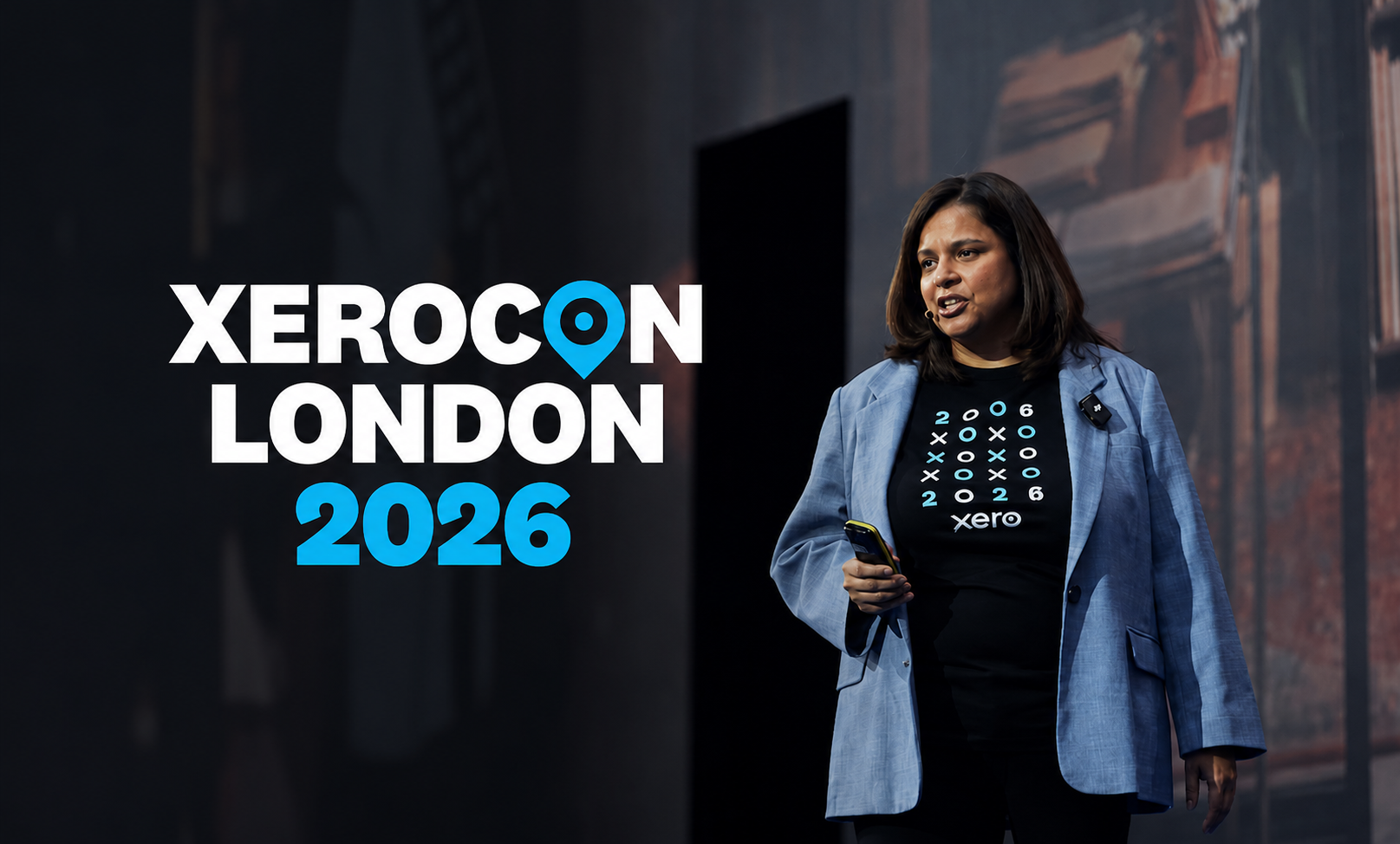
This week I braved the British heatwave, armed with my John Lewis handheld fan, and set foot in my first Xerocon where I was not an employee. Not pacing backstage, not deciding the topics, not firefighting behind the scenes. Just wandering around, taking it all in.
I was there as an observer. "Poacher turned gamekeeper", as a friend of mine put it. So, brandishing my orange press pass, which is apparently code for Xero staff to give me a wide berth, I set about uncovering what is really going on at Xero after four years away from the boardrooms. I have gotta admit, I was bloody impressed with what I found under the hood.
And it wasn't the slick opening act, the flashy keynotes or the buttoned down rhetoric. If I had to sum up Xerocon in one word, it would be coherence.
For the first time in years, it felt like Xero has a strategy where every piece explains every other piece, sitting on a product organisation that feels like it went into the abyss and came out the other side with a new found determination. A battle hardened Xero is a different beast to the Xero of old that had cheerleaders in every corner. A more "high performance" version of Xero changes the landscape for everyone building around it or competing with it.
That is the thin blue thread running through this wrap up. The discipline Xero has found under Sukhinder is exactly what makes it the strongest company it has been in years. And that is what is unsettling the ecosystem of app partners that grew up in its gaps.

Saturn devouring his children?
Xerocon was quieter than the years before. The partner presence was noticeably thinner. The most pointed signal came before the show even opened, when Dext's CEO Sabby Gill publicly announced it was not attending, redirecting its sponsorship money in protest at Xero's shift in API pricing.
That pricing change is the undertone behind a lot of the angst right now. In March, Xero moved its API model from revenue share to tiered usage based billing. For data heavy apps that sync constantly, that is a considerable whack to the cost base. Dext, which connects more accountants and bookkeepers into Xero than almost anything else, feels it at scale, and made a visible choice about where its money goes.
Perhaps the thinner ecosystem presence is a symptom not of the value exchange for going to Xero, but of the harsher reality of the product that Xero is now confidently building itself.
Product is finally producting

Under Sukhinder Singh Cassidy, Xero has been through significant change. Middle management thinned, cost taken out, the whole company reshaped around the Rule of 40 and a sharper focus on profitable growth. The reconfigured reporting tells the story of a company more focused on profit than it has ever been, the natural posture of a maturing business whose growth has slowed.
The narrative that Xero has grown up, got serious about shareholder value and lost some of its founder era romance, is true. But the more interesting shift isn't the new financial discipline, it is the new product foundations.
Hearing CPO Diya Jolly announce change after change signals that Xero is into its third product act: Act 1, Rod Drury's founder-led "ship till it breaks"; Act 2, steady the ship with little visible product because it was so broken; and Act 3, realise all the benefits and vow not to repeat Act 1's sins again. That is what is paying off now, and it is why this year looks different from the last several.
Foundations built on rock, not sand
Here is how the strategy fits together, from the bottom of the stack to the top. This is the part that convinced me, and also the part where the gaps are most revealing.
The foundation is data granularity. Xero holds the highest fidelity record of a business's finances that exists anywhere. Transaction level data, bank feeds, invoices and receipts, all in a single system of record. That granularity is the asset everything else draws on, from compliance and tax through to cash flow and advice. Every layer above depends on it.
On top of the data sits Jax, the copilot. The assistive layer. The most practical application was chasing clients. Almost every bookkeeper will tell you it is the biggest time suck of all. Xero is now building a tool that chases clients down the paperwork at scale, something firms have always grappled with and never quite solved. It attacks the delay-day index directly. Not glamorous, genuinely useful.
Above that sits XeroForce, the orchestration layer, and this is the most important piece. It is Xero's answer to the orchestration threat from the likes of Basis and Combinely, the platform agnostic players that promise to build workflows and do the work across your stack. You describe a workflow in natural language, and XeroForce builds an agent that runs in the background, always on, acting when conditions are met, with a full audit trail. Powered by Xero OS, Xero's AI native operating system, it connects Xero to the third-party tools a firm already uses. The differentiator is decisive. Those agnostic orchestrators coordinate across tools but do not own the ledger data underneath. Xero orchestrates over its own high fidelity record. That is a structural advantage the others cannot easily copy.
Underneath all of it is the harness. Kate Hayward's framing was the most helpful conceptual moment of the event. Deterministic data is not negotiable. The number is, and must always be, the number. What you can do is use agentic AI to build probabilistic workflows around that fixed core. That mirrors how practices actually work. Human judgement is probabilistic. Decisions in a firm are probabilistic. Generative AI used well behaves like an experienced human, except it holds far more context. The harness is the structure of controls, permissions and hard rules that keeps the probabilistic layer safe on top of the deterministic core. Context makes an answer relevant. The harness makes it trustworthy.
One aside worth noting. API requests have shifted fourfold toward end users, accountants and businesses rather than app partners. With vibe coding and Claude, the more sophisticated firms are starting to build their own bespoke surfaces onto Xero, which hints at a future where Xero is the substrate underneath and the surface is something the accountant builds themselves. A quiet tension with the XeroForce pitch that Xero is the orchestration surface, and one to watch.
So the architecture is formidable where it matters, in the middle, with just a quiet contest at the bottom over who owns the surface. That is a stronger position than it sounds, because most of the value is in the middle, and that is exactly where Xero is strongest.
Build, buy, partner: why the ecosystem feels it
A bigger centre to Xero, and fewer app partners on the floor, is a tell.
Xero went through a long phase of acquisition and partnership. The balance of what it builds, buys and partners for has, it seems, begun to move toward build, and it makes total sense. Xero has concluded it has both a responsibility to do more of this work itself and the ability to control that work inside its own product. Putting the US aside, growth is less likely to come from new geographies than from making the core products worth more to a higher value customer. A denser core justifies a higher price. Up market is part of that, but the deeper move is simply making Xero itself provide more value.
The consequence for the ecosystem is unavoidable. If you are a single process app doing one slice of the workflow alongside Xero, the ground is shifting fast. The reconciliation helpers, the pre consolidation tidy up tools, the document capture layers. Much of that category was built to fill gaps left by a slower Xero. As Xero closes those gaps, the bit part role gets harder to defend. If you are a document capture, a reconciler, multi-entity consolidator or reporting app, you are closer still to where Xero is now investing, and that is a more exposed place to be.
None of this is malice. It is rational strategy. But the discomfort is real, and it is the direct by product of Xero finally getting its act together. A lot of the ecosystem was built on the back of Xero's lack of progress. That progress has turned, and it is thoughtful and deliberate.
The mid-market move: real, but unproven
The clearest expression of up market not out market is XeroUltra, the tier aimed at larger, more complex clients, live in Australia and coming to the UK. Multi entity consolidation, advanced reporting, granular permissions. Enterprise capability without the six figure cost of an ERP. The logic is sound in Australia and New Zealand, where dominance means the only way to grow is up. The same instinct now applies in the UK, and it opens two fronts at once.
On one side, the AI native general ledger players making the running in the mid market, the likes of Campfire, Rillet, DualEntry and Light. On the other, and arguably more exposed, the established platforms that have quietly had this space to themselves: iplicit, Sage Intacct and AccountsIQ have built real businesses in the gap above Xero and below full ERP. That gap existed partly because Xero was not serious about it. If Xero is now serious, all of them have reason to be nervous. One of the most interesting UK contests to watch.
The engine behind the move thus far appears to be Syft, the reporting and consolidation tool Xero bought in 2024. The mid-market is a more complicated beast than reporting, and requires a permissions architecture that's hard to retrofit. Xero was built as a simple, ubiquitous, off the shelf product. Serving genuinely large businesses needs the complex authorisation and workflow structures that simplicity likely avoided. Whether Xero can retrofit that depth without losing what made it Xero is the big question.
The eagle hasn't quite landed
Great, so Xero has it all sorted then? Well, er, not quite.
Almost every compelling thing I saw carried a caveat. "In beta." "Coming by the end of the year." The sheer volume of not yets that appeared on the slides and not in the speeches was pretty vast. XeroForce, the piece the entire orchestration thesis rests on, is something you sign up to trial. It is limited to accountants and bookkeepers. And I have still not met a single person using it in anger.
So the honest position is this. The coherence of the strategy is real and demonstrable today. The ability to execute has clearly improved. But the weight of what remains unshipped is pretty heavy, and until XeroForce in particular is in the wild and working, the most important claim is still a promise. Coherence is proven. Execution at this scale is not. That is the thing to watch over the next twelve months.
The sleeper: payroll
One bet was not on the main stage, and it might be among the most consequential.
Xero has flirted with payroll before and never quite made it land. My sense is that quietly, in the background, they are rebuilding it from the ground up as an AI native product. The efficiency headroom for a genuinely AI native payroll is large, and it is exactly the kind of contained, high frequency, rules plus judgement problem that suits the harness model. If Xero has a rebuilt payroll in its back pocket, it deserves more attention than the current noise around it suggests.

The convergence, and the real shift
Step back and a market wide pattern is now unmistakable. Xero and Intuit are both centring the accountant, both explicit that AI works alongside the professional rather than replacing them. It is what Xero brands Accountable Intelligence, the administrative burden handled reliably and at scale, but with human judgement at every step. Artifact AI talks about encoding the "wet code", the tacit knowledge and decision processes of a practice, into a graph. The whole market is arriving at the same place at once. Decisions made in a black box have to be trusted and auditable, and the accountant is central to that trust, not incidental to it.
Which brings me to the shift that matters most. The tools to actually deliver the back office are finally arriving inside Xero, through its redesigned partner hub. That is what frees the accountant to do the higher value work. The most exciting version is advisory, and the clearest example I saw came from the Syntax.tax team, using data inside Xero to automatically recommend tax relief and optimise the tax position. That is the shape of the future. Not AI replacing the accountant, but AI clearing the ground so the accountant can advise.
The verdict
I came in a weathered sceptic. I left having upgraded my view of Xero substantially, and that upgrade is reflected in the A to Z.
Xero has stopped leaving gaps. That is the best thing that has happened to it in years, and the most uncomfortable thing that has happened to the ecosystem around it.